
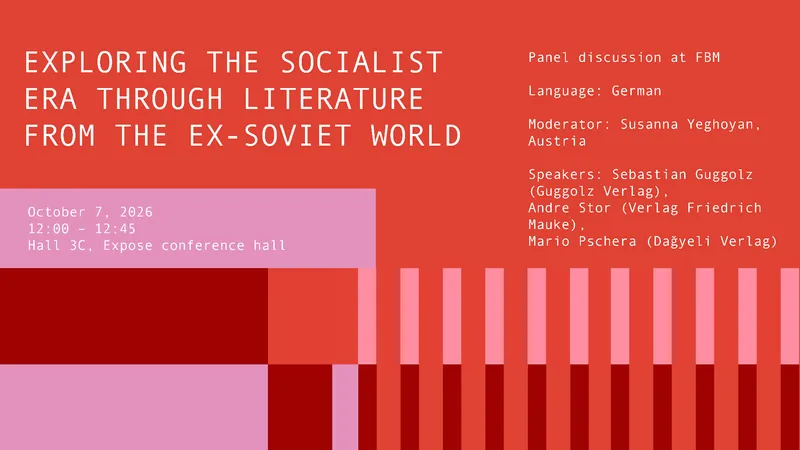
Exploring the Socialist Era Through Literature from the Ex-Soviet World

Foundation for Development of Culture
ArmeniaAbout
This panel brings together German publishers who have played a significant role in introducing Armenian
literature to German-speaking audiences in recent years. Their catalogues encompass a broad spectrum
of works, spanning dierent historical periods, literary genres, and aesthetic traditions—from oncebanned
Soviet-era classics to contemporary literary fiction, short stories, novellas, and novels from all
over ex-soviet region.
Taken together, these publications oer a nuanced and multifaceted perspective on society, illuminating
the complexities of everyday life under Soviet rule, the turbulent transition to independence, and the
ongoing negotiation of identity in the post-Soviet era. Rather than presenting a singular historical
narrative, they reveal the plurality of voices and experiences that have shaped Armenia's cultural and
political imagination.
At a time of renewed international interest in the South Caucasus, and amid competing geopolitical
projects seeking to define the region's future, literature oers a unique lens for examining questions of
historical memory, social transformation, and cultural self-understanding. The discussion will explore
how Armenian literature engages with the legacies of the Soviet past, reflects on the challenges of the
present, and contributes to broader debates about belonging, sovereignty, and Armenia's place between
Russia and Europe. It will also consider the role of literary translation and publishing in shaping
international perceptions of the region and facilitating cross-cultural dialogue.
The discussion will address the opportunities and challenges of publishing literature from smaller
language markets, the importance of literary mediation, and the role of publishers in creating meaningful
connections between cultures.
Moderator: Susanna Yeghoyan, Austria
Speakers: Sebastian Guggolz (Guggolz Verlag), Andre Stor (Verlag Friedrich Mauke), Mario Pschera
(Dağyeli Verlag)