Merz Akademie, University of Applied Arts, Design and Media
Germany
About
Merz Akademie is a state-recognized, non-profit university for design, art, and media in Stuttgart. With its interdisciplinary profile at the intersection of art, design, humanities, technology, and social transformation, it positions itself as an innovative learning environment between an art academy, a university of applied sciences, and a humanities faculty. Founded in 1918 by architect and reform educator Albrecht Leo Merz, the Merz Akademie was state-recognized in 1985 under the initiative of his grandson Markus Merz by the State of Baden-Württemberg. As rector, he shaped the university for 35 years with an innovative concept of interdisciplinary integration between theory and practice. Since 2023, the artistic and academic direction of the institution has been led by art historian and scholar of comics Dr Barbara M. Eggert. Among other things, she advocates for the expansion of the existing range of accredited study programs, which are committed both to an advanced understanding of media authorship and to meeting the demands of professional practice across the broad field between art and media technology.
On the Bachelor of Arts program Design, Art and Media, students learn not only to understand social, cultural and technological developments, but also to play an active role in shaping them. The Bachelor of Arts program combines design, theory and technology. The study areas of Emerging Media, Film and Video, New Media and Visual Communication can be freely combined or explored in greater depth to form specialisations such as photography, illustration, graphic design or AR/VR/3D. Small groups, close supervision and an integrated practical semester ensure that the program is hands-on and personalised.
The international Master of Arts program Research in Design, Art and Media – Designing the Future offers students considerable freedom in shaping their curriculum and in the media-based approach to their individual projects. This 3- or 4-semester on-campus program focuses on the development and implementation of students’ individual projects, enabling them to refine and deepen their filmic, artistic, design-related, theoretical or activist practice across different media and throughout the duration of the program, under constructive and critical supervision and guidance. In doing so, they benefit from synergies with students from other disciplines and can acquire any missing technical skills through the facilities offered by the Merz Academy in its labs (Virtual Reality, Sound Studio, Green Screen, Media Lab, Photography Studio, Screen Printing Workshop, Print/Scan Lab, Bookbinding Workshop).
Our Events
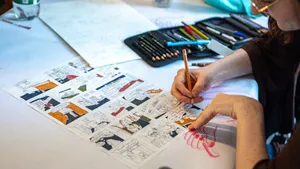


Comic trifft Comicforschung
